There’s a version of lawn care where the equipment gets sharpened at the start of the season, maybe once more in the middle if someone remembers, and that’s about it. A lot of lawn services operate that way. The homeowner rarely knows, and the results show up subtly — a lawn that looks okay but never quite looks sharp, a faint brownish cast across the grass that gets blamed on heat or watering.
We do it differently. Every week, without exception, our mowing equipment goes through a full maintenance session before it touches another lawn. Here’s what that actually involves, why it matters more than most people realize, and what it means for the lawn you’re paying us to take care of.
How Often Do Mower Blades Actually Go Dull?
The honest answer is: faster than you’d think, especially at commercial volume.
Think about what a mower blade actually does. It spins at high speed and slices through millions of individual grass blades on every pass. Even on a perfectly clean, debris-free lawn, that volume of cutting dulls a blade over time — it’s the same principle as any cutting edge used repeatedly. But lawns aren’t perfectly clean. Every time a blade clips a small rock, a pinecone, a buried tree root, or a stray branch, it takes a micro-hit to that cutting edge. Enough of those hits and the blade goes from slicing cleanly to tearing.
For a homeowner mowing their own lawn thirty times over the course of a season, a sharpening at the start of the year and maybe once more mid-season is probably adequate. Our crews mow fifty to sixty lawns per week. The math on blade wear is completely different at that volume. A blade that would last a homeowner a full season can go dull on us in a week of heavy use. Weekly sharpening isn’t us being overly cautious — it’s the minimum that makes sense given how hard our equipment works.
What a Dull Blade Actually Does to Your Lawn
A sharp blade cuts. A dull blade tears. That distinction sounds simple, but the effect on your lawn is real and visible.
When a blade tears rather than cuts cleanly through a grass blade, it leaves a ragged, damaged tip on each individual strand of grass. Those damaged tips dry out and turn brown. Across an entire lawn, that shows up as a dull, brownish cast — a lawn that looks tired and stressed even when it’s been watered properly and is otherwise healthy. A lot of homeowners assume it’s a watering issue or a heat issue. Often it’s a blade issue.
A freshly sharpened blade leaves a clean, precise cut on every grass blade it passes through. The tips stay green. The lawn looks crisp. It’s one of those things that’s hard to quantify but easy to see — a lawn maintained with sharp blades consistently looks better than one that isn’t, week after week, all season long.
The Weekly Maintenance Process
Every weekend, our equipment goes through a scheduled maintenance session in our shop. This isn’t something that happens when there’s time — it’s planned, required, and non-negotiable. It takes roughly one to two hours per machine depending on the equipment, and it covers three things that directly affect cut quality: blade sharpening, deck cleaning, and chute and collector cleaning.
Blade Removal and Sharpening
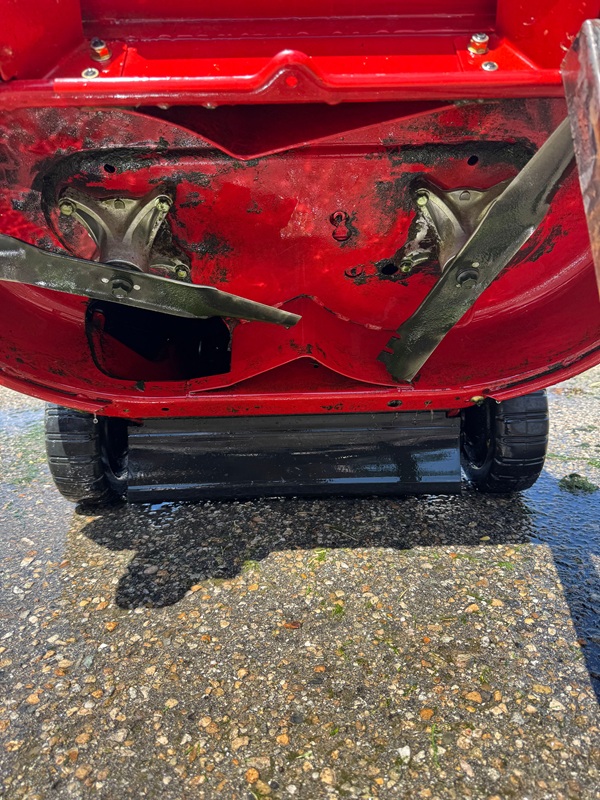
We use a specialized lift tool to raise the front end of each mower and expose the underside of the deck. With the deck accessible, the blades come off for sharpening. The goal is always the same: restore that sharp, precise leading edge — the same scissor-like geometry the blade had when it was new. Any nicks or damage from the week get ground out. The edge gets brought back to clean and sharp before the blade goes back on.
Blades don’t last forever. When a blade has been sharpened enough times that the geometry can’t be properly restored, or when damage from an impact is significant enough that sharpening won’t fix it, it gets replaced. Running a damaged blade isn’t something we do — it affects cut quality and puts unnecessary stress on the machine.
Deck Cleaning
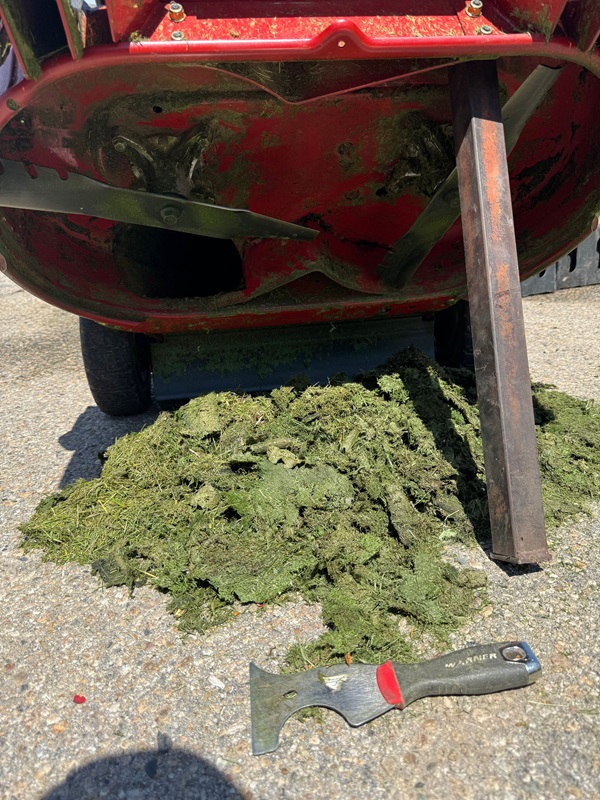
With the blades removed and the deck fully exposed, we hand scrape the accumulated grass out of the deck interior, then hit it with a pressure washer until it’s genuinely clean. This step matters more than most people realize, and here’s the best way to think about it.
A mower deck works partly like a vacuum. As the blade spins at high speed, it creates airflow that lifts the grass upright before the blade cuts it — which is what allows for a clean, even cut — and then moves the clippings up through the chute and into the collector. That airflow depends on the deck interior being clear. When dried grass accumulates and cakes onto the deck walls and ceiling, it restricts that airflow. Less airflow means the grass doesn’t lift as cleanly before it’s cut, the clippings don’t move through the chute as efficiently, and more ends up left behind on the lawn in clumps rather than collected or mulched properly.
Most homeowners clean their mower deck once a season, maybe. For someone mowing their own lawn thirty times a year with a residential machine, that’s arguably fine. For commercial equipment running fifty to sixty lawns a week, a dirty deck after just a few days of use is enough to noticeably affect performance. Weekly cleaning keeps the system working the way it’s supposed to.
Chute and Collector Cleaning
The same principle applies to the discharge chute and grass catcher. Buildup anywhere along the path that clippings travel restricts airflow and reduces collection efficiency. We clean these out fully every week as part of the same session. A clean system from blade to collector means the mower performs consistently from the first lawn of the week to the last.
New Equipment, Maintained Like It Matters
We run commercial-grade mowing equipment exclusively, and our business plan calls for replacing that equipment on a three-year cycle — selling it and investing in new machines before age and heavy use start affecting reliability and performance. Commercial equipment is built to handle the workload we put it through, and keeping it on a replacement cycle means our clients always have the benefit of newer, well-performing machines rather than aging equipment that’s being run past its prime.
We also keep spare parts — belts, shear pins, and other common wear items — on our trucks at all times. Minor roadside repairs happen in the field without disrupting a client’s scheduled mow. And if a machine does have a more significant issue, we have backup equipment available. Our clients’ schedules don’t get rescheduled because of a mechanical problem on our end.
Why This Shows Up in Your Lawn
All of this — the weekly sharpening, the pressure-washed decks, the clean chutes and collectors, the newer commercial equipment — adds up to one thing from the client’s perspective: a lawn that consistently looks better than one maintained with less care.
Sharp blades mean clean cuts and green tips instead of torn grass and browning. Clean decks mean proper airflow and consistent clipping collection instead of clumps left across the surface. Well-maintained equipment means a uniform cut height across the entire lawn rather than the inconsistencies that come from machines running below their potential.
It’s not the most glamorous part of running a lawn care operation, but it might be the most important one. The work we do in the shop on weekends is what makes Monday through Friday look the way it does.
If you’d like to learn more about what goes into our weekly mowing visits — the alternating mow directions, the edging technique, the blowing routine — our post on what makes a professional weekly mowing service different covers all of it. And if you’re ready to get on our schedule for the season, we’d love to hear from you.
1-208-398-0357
Request a free quote at Alive-Green.com